Revenue Growth Strategy for Founder-Led B2B: A Practical 12-Month Plan
Learn how to build a sustainable revenue growth strategy for your B2B business with this practical 12-month framework covering positioning, pipeline development, and margin protection.
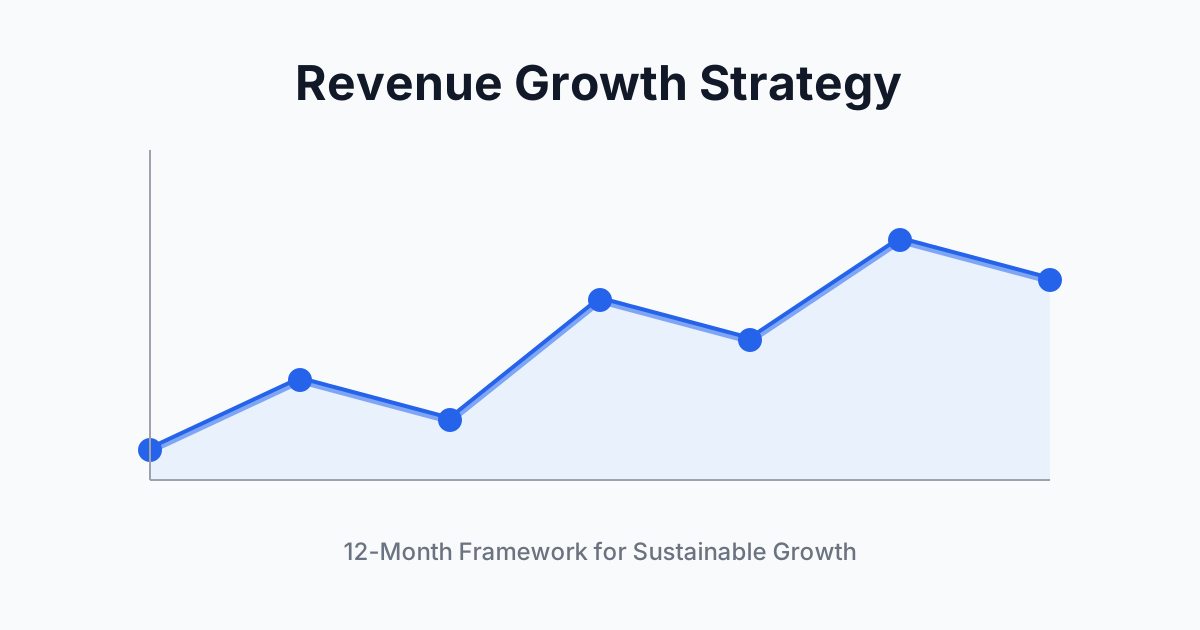
Growing revenue in a founder-led B2B business requires more than just working harder. It demands a systematic approach that balances new customer acquisition with retention, whilst protecting your margins and maintaining quality of delivery. This guide provides a practical 12-month framework that founder-led businesses between £50K and £5M+ can adapt to their specific context.
Why Traditional Growth Advice Fails Founder-Led Businesses
Most revenue growth advice assumes you have a dedicated sales team, significant marketing budget, and separate operations. Founder-led businesses operate differently. you are often the chief salesperson, lead delivery person, and strategic decision-maker simultaneously.
This creates unique constraints: your time is finite, cash flow matters more than venture-backed metrics, and you can't afford to sacrifice delivery quality for growth. Any growth strategy must work within these realities, not ignore them.
The framework in this guide acknowledges these constraints. It focuses on leverage points where small, consistent actions compound over time rather than requiring unsustainable bursts of activity.
The 12-Month Revenue Growth Framework
Months 1-3: Foundation and Positioning
Start by clarifying your positioning and ideal customer profile. Many founders skip this step, but unclear positioning creates expensive inefficiencies downstream. Document exactly who you serve, what specific problem you solve, and why clients choose you over alternatives.
Audit your current pipeline and conversion process. Where do leads enter? What percentage progresses to each stage? Where do they drop off? This baseline data is essential for measuring improvement.
Create your core content assets: case studies, testimonials, and a clear articulation of your methodology or framework. These assets reduce the time you spend explaining your value in every sales conversation.
Months 4-6: Pipeline Development
Focus on building consistent pipeline generation. For most founder-led businesses, this means a combination of warm outreach, referral systems, and strategic content distribution rather than cold outbound at scale.
Implement a simple CRM or pipeline tracking system if you haven't already. Spreadsheets work fine initially. The goal is visibility into pipeline health and the ability to forecast revenue 60-90 days ahead.
Develop your lead generation system with 2-3 channels that fit your strengths. If you're strong at speaking, pursue podcast appearances and webinars. If you prefer writing, focus on LinkedIn and industry publications.
Months 7-9: Conversion and Packaging
Optimise your conversion process. Most founder-led businesses have decent close rates with qualified prospects but struggle with qualification and proposal efficiency.
Review your pricing and packaging. Can you create clear service tiers that make buying decisions easier? Can you reduce custom proposals in favour of configurable packages?
Implement structured sales conversations. A consistent framework for discovery and proposal reduces the mental overhead of each sales interaction whilst improving conversion rates.
Months 10-12: Retention and Expansion
Shift focus to retention and expansion revenue. For most B2B businesses, retention significantly impacts unit economics. A customer retained for 36 months is worth dramatically more than one who churns after 12.
Build your retention system with proactive check-ins, clear success metrics, and structured expansion conversations.
Implement quarterly business reviews with key accounts. These create opportunities for expansion whilst reducing churn risk by surfacing issues before they become crises.
Key Metrics to Track
Focus on a small set of metrics you'll actually monitor weekly:
**Pipeline Metrics**: Number of qualified opportunities, average deal size, pipeline velocity (time from first contact to close), conversion rate by stage.
**Revenue Metrics**: Monthly recurring revenue (if applicable), new revenue booked, expansion revenue from existing clients, churn rate.
**Efficiency Metrics**: Customer acquisition cost, lifetime value, gross margin by service line, founder time allocation.
These metrics should fit on a single dashboard you can review in under 10 minutes. Complex analytics systems rarely get used in founder-led businesses. Simple, consistent tracking beats sophisticated systems that get abandoned.
Adapting the Framework to Your Context
This framework is a starting point, not a rigid prescription. Businesses at £50K need different tactics than those at £2M. Service businesses have different dynamics than SaaS.
If you're earlier stage (under £250K), compress the timeline. Focus on months 1-6 over six months rather than twelve. You need revenue momentum more than perfection.
If you're more established (£1M+), extend the timeline and go deeper on each phase. You can afford to be more methodical and test multiple approaches in parallel.
For businesses with strong existing revenue but inconsistent growth, focus on months 7-12. Your primary opportunity may be optimising what you already have rather than adding new channels.
Common Mistakes to Avoid
- ✗Trying to execute every tactic simultaneously instead of sequencing them properly
- ✗Copying strategies from venture-backed companies with fundamentally different economics
- ✗Optimising for vanity metrics (social media followers, website traffic) instead of pipeline and revenue
- ✗Neglecting existing customer retention whilst pursuing new customer acquisition
- ✗Failing to track baseline metrics, making it impossible to measure what actually works
- ✗Building complex systems that require more maintenance than they provide value
- ✗Discounting aggressively to close deals, training the market to expect low prices
- ✗Pursuing enterprise clients without the delivery infrastructure to serve them well
Example Scenario: Applying the Framework
Consider a marketing consultancy at £300K annual revenue with one founder and two contractors. Currently, 80% of revenue comes from two long-term clients. New clients arrive inconsistently through referrals, creating unpredictable cash flow.
**Months 1-3**: The founder clarifies positioning around "demand generation for B2B SaaS companies scaling from £1M to £10M". She documents her methodology as a framework, creates two detailed case studies, and maps her pipeline process (currently just informal conversations).
**Months 4-6**: She implements a simple pipeline tracker, launches a LinkedIn content series sharing frameworks from client work (with permission), and begins proactive referral requests from existing clients. Pipeline grows from 1-2 conversations to 5-8 qualified opportunities.
**Months 7-9**: She packages services into three clear tiers rather than custom proposals for everything. Conversion rate improves from 30% to 45% because prospects can compare options easily. She reduces time per proposal from 8 hours to 2 hours.
**Months 10-12**: She implements quarterly business reviews with existing clients, uncovering expansion opportunities worth £80K. She also identifies early warning signs with one major client and addresses concerns before they consider leaving.
By year end, revenue has grown to £520K with healthier diversification (no client above 30%), more predictable pipeline, and better margins due to packaged services. This growth was achieved without hiring full-time staff or dramatically increasing hours worked.
Frequently Asked Questions
How much revenue growth can I expect from implementing this framework?
Results vary significantly based on starting point, market conditions, execution quality, and specific circumstances. Some businesses see 20-30% growth, others achieve 50-100%+ growth. The framework provides structure, but outcomes depend on your market, offer strength, execution, and existing baseline. This is educational guidance, not a guarantee of specific results.
Do I need to hire a sales team to implement this?
No. This framework is specifically designed for founder-led businesses where the founder remains the primary salesperson. As you grow, you may choose to hire, but the framework works without requiring a sales team. In fact, many tactics become easier to execute as a founder because you can make decisions and adapt quickly.
How much time per week does this require?
Expect to allocate 5-10 hours per week on growth activities initially, reducing to 3-5 hours per week once systems are established. This includes pipeline development, sales conversations, content creation, and metrics review. The framework emphasises leverage and systems to avoid requiring unsustainable time investment.
What if I am in a very niche market with limited prospects?
Niche markets require adapted tactics but the framework still applies. Focus more on retention and expansion (months 10-12) since customer lifetime value matters more when acquisition volume is constrained. Consider adjacent markets or vertical expansion once you dominate your initial niche.
Should I focus on new customer acquisition or expansion revenue?
Both matter, but the optimal balance depends on your stage. Earlier businesses (under £500K) typically need more focus on new customer acquisition to diversify risk. More established businesses (£1M+) often find expansion revenue more efficient. Aim for at least 20-30% of growth from existing customers regardless of stage.
How do I adapt this framework if I offer productised services or SaaS?
The core framework applies across business models, but tactics differ. SaaS businesses should emphasise trial-to-paid conversion and expansion revenue more heavily. Productised service businesses benefit from clearer packaging and self-service buying where possible. The fundamental principle-systematic improvement across pipeline, conversion, and retention-remains constant.
Ready to Build Your Growth Plan?
This framework provides structure, but implementation requires adapting it to your specific business context, current constraints, and growth goals.
Get your personalised 90-day growth roadmap: Our AI-powered planning tool captures your baseline KPIs, identifies your biggest bottlenecks, and generates a prioritised action plan tailored to your business. Start your free assessment and get clear next actions in 30 minutes.
Want to explore pricing and service options? View our plans or contact us to discuss your specific growth challenges.
Related Guides
B2B Lead Generation System: From Positioning to Pipeline
Build a systematic B2B lead generation engine that delivers consistent, qualified pipeline without relying on paid advertising or large sales teams.
Read guide →Pricing & Packaging: Increase Revenue Without Increasing Workload
Strategic pricing and service packaging approaches that improve profitability, simplify buying decisions, and reduce custom proposal overhead for B2B service businesses.
Read guide →Retention & Expansion: Improve LTV and Reduce Churn
Build systematic client retention and expansion revenue programmes that improve lifetime value, reduce churn, and create predictable growth from your existing customer base.
Read guide →Conversion Rate Optimisation (CRO) for Service Businesses
Improve your conversion rates from enquiry to client with systematic optimisation of your sales process, proposals, and buying experience for B2B service businesses.
Read guide →