Conversion Rate Optimisation (CRO) for Service Businesses
Improve your conversion rates from enquiry to client with systematic optimisation of your sales process, proposals, and buying experience for B2B service businesses.
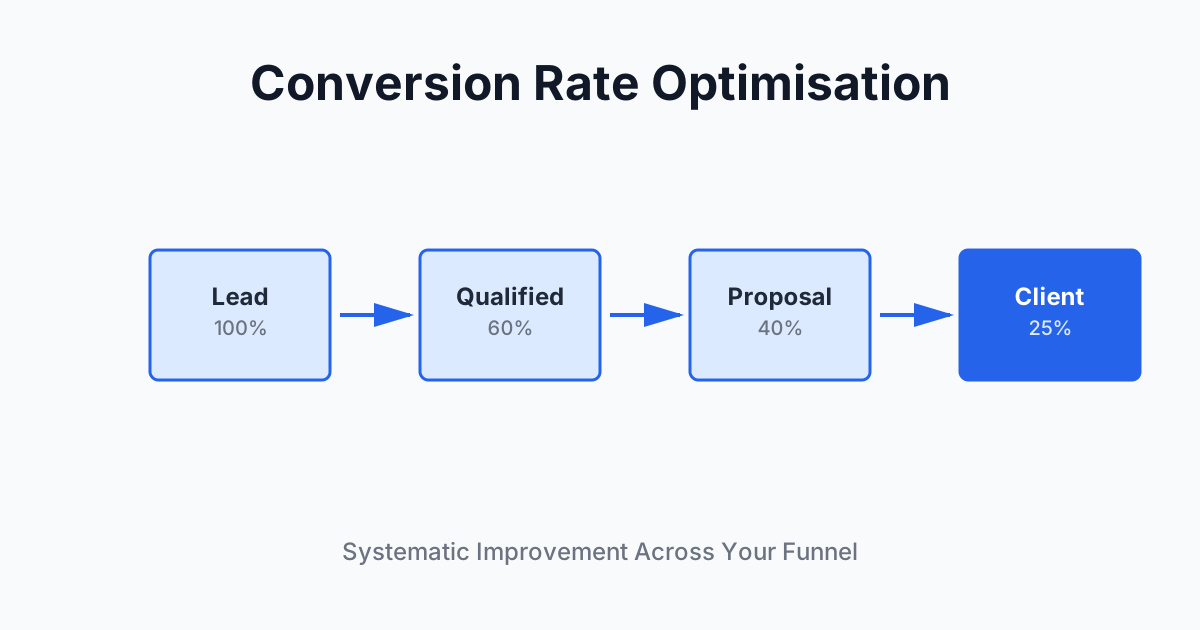
Most B2B service businesses focus on generating more leads when improving conversion rates would have greater impact. A modest improvement from 20% to 30% conversion delivers 50% more revenue from the same pipeline. This guide explores systematic conversion optimisation for service businesses, where buying decisions involve high consideration, multiple stakeholders, and significant perceived risk.
Why Service Business Conversion Is Different
Conversion rate optimisation (CRO) in e-commerce focuses on website usability, checkout friction, and incremental testing. Service business CRO operates differently. Buying decisions take weeks or months, involve multiple conversations, and depend heavily on trust and perceived expertise.
You can't A/B test your way to dramatically better conversion rates when each prospect has unique needs and buying contexts. Instead, systematic improvement comes from identifying patterns in why prospects buy or don't buy, then addressing the most common friction points.
Service business conversion happens across multiple touchpoints: initial enquiry response, discovery conversation, proposal quality, follow-up cadence, and closing conversation. Each represents an opportunity to increase or decrease conversion likelihood.
The goal is not aggressive sales tactics that pressure prospects into buying. That creates buyer's remorse, difficult client relationships, and poor retention. Effective conversion optimisation makes the buying decision easier for prospects who genuinely fit your services whilst helping poor-fit prospects self-select out earlier.
This approach improves close rates whilst also improving client quality-a rare combination where the same actions drive multiple positive outcomes.
Mapping Your Current Conversion Funnel
Start by documenting your current conversion process and measuring conversion rates at each stage. Most service businesses have a funnel like: initial enquiry, qualification conversation, discovery/scoping, proposal submitted, negotiation/questions, closed won or lost.
Calculate conversion rates between each stage over the last 6-12 months. Where do you lose the highest percentage of prospects? This is where optimisation efforts will have the greatest impact.
Common patterns include: high drop-off after initial enquiry (often indicates slow response time or unclear qualification), strong conversion from discovery to proposal but low proposal-to-close (suggests pricing/value communication issues), and high close rates but long sales cycles (indicates decision-making friction rather than fundamental objections).
Track reasons for lost opportunities. Create a simple classification: price too high, chose competitor, timing not right, no longer need solution, ghost/no response. Patterns in loss reasons reveal specific optimisation opportunities.
Also measure cycle time from initial enquiry to close. Long sales cycles aren't always problems, but understanding your baseline helps you identify bottlenecks and measure improvement. For earlier-stage businesses, see how this fits into overall revenue growth strategy.
Optimisation Strategies by Funnel Stage
Initial Response and Qualification
First response time dramatically impacts conversion. Prospects who wait more than 24 hours for initial response are significantly less likely to convert than those who receive response within hours.
Create response templates for common enquiry types, but customise them with specific relevance to each prospect's situation. The goal is speed plus relevance, not just speed.
Use initial response to set expectations about next steps, qualifying questions, and timeline. Uncertainty creates anxiety; clarity builds confidence.
Qualify prospects early and explicitly. Ask about budget, timeline, decision-making process, and current situation. This feels uncomfortable initially but saves time and improves conversion by focusing effort on viable opportunities.
If a prospect is not a good fit, say so clearly and helpfully. Refer them elsewhere if possible. This builds goodwill (they may return later or refer others) and frees your time for better-fit prospects.
Discovery and Scoping Conversations
Structure discovery conversations with a consistent framework. This ensures you gather necessary information whilst demonstrating expertise through the questions you ask.
Effective discovery balances questions (understanding their situation) with insights (demonstrating expertise). A purely interrogative conversation feels one-sided. Sharing relevant frameworks or observations based on their answers builds credibility.
Use discovery to uncover budget and decision-making process, not just technical requirements. Many service providers avoid money conversations until proposal stage, then face unexpected objections. Discuss budget ranges early: "Projects like this typically range from X to Y depending on scope. Is that in the range you're considering?"
Document discovery thoroughly. Nothing damages credibility like asking prospects to repeat information they already provided. Good notes also ensure your proposal directly addresses their specific situation.
End discovery with clear next steps and timelines. If you'll send a proposal by Friday, commit to that publicly. If you need additional information first, specify exactly what and when.
Proposals That Convert
Most proposals are too long, too generic, or too focused on credentials rather than the prospect's specific situation and desired outcomes.
Structure proposals as: summary of their situation and goals (proving you understand them), recommended approach (why this methodology addresses their needs), specific deliverables and timeline (clear scope), investment and options (pricing), and next steps (making the buying decision easy).
Lead with value and outcomes, not process. Prospects care more about what they'll achieve than how you'll do the work. Process detail matters but should follow outcome framing.
Offer options where appropriate. Many prospects aren't deciding whether to work with you, but which version of your service to buy. Three tiered options (good, better, best) often improve both conversion and average deal size compared to single proposals.
Make proposals scannable. Use headers, bullet points, and visual hierarchy. Decision-makers rarely read proposals linearly; they scan for key information.
Include clear next steps and make saying yes easy. Specify exactly how they accept, what happens next, and when work begins. Friction in the buying process kills deals.
Follow-Up and Objection Handling
Most deals that die do so from lack of follow-up, not from fundamental objections. Prospects get busy, decision-making gets delayed, proposals sit unreviewsed.
Implement systematic follow-up cadence. If a prospect goes quiet after proposal submission, a sequence like: 2 days, 5 days, 10 days, 20 days helps. Vary communication method (email, LinkedIn, phone) and approach (checking in, sharing relevant resource, asking if questions arose).
When objections surface, view them as information, not rejection. "This is more expensive than we expected" might mean their budget is genuinely constrained, they don't fully understand the value, they're comparing to an inappropriate alternative, or they're using price as a proxy for other concerns.
Probe objections with questions: "Help me understand what you were expecting?" or "What alternative approach were you considering?" This uncovers the real issue rather than accepting the stated objection at face value.
Common objections and potential responses include price (reframe around outcomes and ROI, offer phased approach, or discuss scope reduction), timing (explore what would need to change for timing to work, maintain relationship for future), and need to think about it (identify specific concerns, offer to address questions, set concrete follow-up date).
See our guide on pricing and packaging for more on positioning your pricing effectively to reduce price objections.
Conversion Rate Benchmarks and Goals
Service business conversion rates vary enormously by industry, deal size, sales cycle, and lead source. Typical ranges include: enquiry to qualified opportunity (30-60%), qualified opportunity to proposal (60-80%), proposal to closed (20-40%), and overall enquiry to closed (10-25%).
Higher-ticket services generally have lower conversion rates but higher revenue per deal. Transactional services have higher conversion but lower deal value. Compare yourself to your own baseline, not published benchmarks from businesses with different models.
Set conversion improvement goals modestly. A 5-percentage-point improvement in close rate (from 25% to 30%) is significant and impactful. A 20-point improvement is unrealistic without fundamental changes to positioning, service offering, or target market.
Track conversion rates by lead source. Referrals typically convert at 40-60%, inbound leads at 20-35%, and cold outbound at 5-15%. These differences reflect lead quality and trust level, not just sales process quality.
Focus optimisation efforts on your highest-volume stages first. If 100 enquiries convert to 60 opportunities but only 12 close, focus on proposal-to-close (20% rate) before enquiry-to-opportunity (already strong at 60%).
Advanced Conversion Tactics
Once fundamentals are solid, several advanced tactics can further improve conversion rates.
**Social proof integration**: Weave relevant case studies and testimonials throughout the buying process, not just on your website. During discovery, mention similar clients and outcomes. In proposals, include brief case study summaries of similar work.
**Risk reversal**: Reduce perceived risk with guarantees, phased approaches, or pilot projects. "let us start with a 30-day diagnostic project. If the value isn't clear, you're under no obligation to continue" lowers commitment anxiety.
**Time-based incentives**: Strategic use of deadlines can spur decisions without feeling manipulative. "We have capacity starting 15th February. After that, the next available start date is late March" creates legitimate urgency.
**Multi-threading**: Engage multiple stakeholders on the prospect's side. Deals single-threaded through one champion are vulnerable to that person leaving, getting overruled, or losing interest. Build relationships with other decision-makers and influencers where possible.
**Post-proposal calls**: Rather than sending proposals and hoping, schedule a follow-up call 2-3 days later to walk through it together. This surfaces questions immediately and maintains momentum.
For businesses focused on retention after conversion, see our retention and expansion guide.
Common Conversion Optimisation Mistakes
- ✗Focusing solely on generating more leads instead of converting existing pipeline better
- ✗Sending proposals without confirming budget and decision-making authority first
- ✗Creating proposals that are too long, too generic, or too focused on credentials
- ✗Giving up after one or two follow-up attempts when prospects go quiet
- ✗Failing to track conversion rates by stage, making optimisation impossible
- ✗Using aggressive sales tactics that create short-term closes but long-term problems
- ✗Accepting stated objections (especially price) without probing for underlying concerns
- ✗Optimising for maximum close rate instead of optimal client fit
- ✗Treating all prospects identically instead of adapting approach based on segment and context
Example Scenario: Systematic Conversion Improvement
Consider a management consultancy with a 15% overall conversion rate from enquiry to close. They generate 40 enquiries per month but only close 6 deals, creating revenue unpredictability.
**Initial Analysis**: They mapped their funnel and found: 40 enquiries → 24 qualified opportunities (60%) → 18 proposals submitted (75%) → 6 closed (33%). The weakest stage was proposal-to-close, not lead quality.
**Month 1-2 Focus**: They revised their proposal template to lead with client situation and desired outcomes rather than consultant credentials. They created three service tier options instead of single custom proposals. They implemented a post-proposal review call 3 days after sending proposals.
**Results**: Proposal-to-close conversion improved from 33% to 42%. With the same 18 proposals per month, they now close 7-8 deals instead of 6-a 25% revenue increase without any additional lead generation.
**Month 3-4 Focus**: They addressed initial response time. Previously, enquiries sat for 24-48 hours before response. They implemented same-day response (within 4 hours during business hours) with customised templates.
**Results**: Enquiry-to-opportunity conversion improved from 60% to 68%, generating 27 qualified opportunities instead of 24 from the same 40 enquiries.
**Combined Impact**: Same 40 monthly enquiries now produce 27 opportunities, 20 proposals, and 8-9 closes (22.5% overall conversion, up from 15%). This 50% increase in deals from identical lead generation is worth substantially more than generating 20 additional enquiries at the original 15% conversion rate.
Frequently Asked Questions
What is a good conversion rate for B2B service businesses?
Conversion rates vary widely by deal size, sales cycle, and lead source. Overall enquiry-to-close rates of 10-25% are common. Referrals might convert at 40%+, whilst cold outbound might be 5-10%. Focus on your own baseline and improvement trends rather than comparing to published benchmarks from different business models.
How quickly will I see improvement from CRO efforts?
Some changes (faster response time, better follow-up) can impact results within weeks. Others (proposal improvements, discovery process changes) require completing full sales cycles before measuring impact, which might be 30-90 days depending on your typical cycle. Expect to see meaningful trends within a quarter of consistent implementation.
Should I focus on conversion rate or deal size?
Both matter, but improving conversion is often faster than increasing deal size. A 5-point improvement in close rate delivers immediate results. Increasing average deal size typically requires packaging changes, positioning shifts, or moving upmarket-valuable but more complex. Do both over time, but conversion improvements often deliver faster wins.
How do I improve conversion without being pushy or aggressive?
Effective conversion optimisation makes buying easier for good-fit prospects, not pressuring poor fits into buying. Focus on clarity, reducing friction, addressing questions promptly, and making the decision process straightforward. This approach improves conversion whilst also improving client quality-prospects who need more pressure typically become difficult clients.
What if my conversion rate is already high?
High conversion rates (40%+ from enquiry to close) might indicate you are underpricing, not generating enough top-of-funnel volume, or attracting only very warm leads. These aren't necessarily problems. Focus on whether your total revenue and profitability meet your goals. If yes, conversion may not be your constraint. Consider <a href="/guides/b2b-lead-generation-system" class="text-blue-600 hover:underline">lead generation</a> instead.
Improve Your Conversion Rates
Systematic conversion improvement starts with understanding your current funnel, identifying the highest-impact opportunities, and implementing changes methodically whilst measuring results.
Get your conversion optimisation plan: Our assessment tool analyses your current conversion funnel and identifies your top 3 improvement opportunities. Get your free assessment in under 30 minutes.
Explore how conversion optimisation fits into broader revenue growth with our revenue growth strategy guide, or learn how better pricing and packaging can reduce price objections and improve conversion.
Related Guides
Revenue Growth Strategy for Founder-Led B2B: A Practical 12-Month Plan
Learn how to build a sustainable revenue growth strategy for your B2B business with this practical 12-month framework covering positioning, pipeline development, and margin protection.
Read guide →B2B Lead Generation System: From Positioning to Pipeline
Build a systematic B2B lead generation engine that delivers consistent, qualified pipeline without relying on paid advertising or large sales teams.
Read guide →Pricing & Packaging: Increase Revenue Without Increasing Workload
Strategic pricing and service packaging approaches that improve profitability, simplify buying decisions, and reduce custom proposal overhead for B2B service businesses.
Read guide →